When creating a fantasy world, especially if it’s your first time, it’s easy to lose your way chasing endless magical possibilities. But if your goal is to actually finish your manuscript, you need a sturdier container to keep your ideas from growing too big to handle.
The point is this: A magic system that doesn’t serve the narrative of your book will just create clutter and confusion for yourself and your reader. While the complexity of your system can depend on how epic your fantasy world is, common reader complaints include getting too much information, too soon, and without any context.
New magic systems need to be invented for every new series you create, making it beyond important to have a solid methodology to get you started. Otherwise, you could end up running in circles without a clear vision for how you’re telling your story.
First, I want you to remember the last time you cracked open a new Fantasy novel and said, “Wow! I love how little any of this makes sense!”
…Yeah, that probably didn’t happen. You’re more likely to put it back on the shelf long before it ever hits your DNF pile.
Meanwhile, other books start with such a loosey-goosey grip on the “fantasy” elements that you can only wonder if the author actually meant to write Fantasy or a rehash of every cliche under the sun. This kind of inconsistency is common for first-time writers who love the vibe of magic but don’t have a solid grasp on the fundamentals.
That’s why, for this article, we are going to take a deep dive not just into what magic systems are, but also how to make them the beating heart of your story.
First, let’s get some definitions out of the way. A magic system is a detailed framework of how magic works in a fictional, fantasy setting. It is crafted with specific rules, logic, and restrictions to make the Fantasy feel realistic while still sparking the reader’s imagination.
Magic systems can also be classified by their complexity, and different genres tend to prefer one type over another. A hard magic system has detailed rules, limits, and uses. It’s as close to our understanding of science, often because of how integral it is to the fabric of the universe. LitRPGs especially rely on these to create challenges and triumphs for the plot. Epic Fantasies tend to lean this way as well so they can stand out from others in this dominant genre.
Meanwhile, a soft magic system is typically more fluid and all-powerful, or at least is more mysterious. If your characters are tapping into a source that seems to have a mind of its own or defies definition, that’s what makes it soft. These systems create a feeling of grandness that’s hard to explain, making it a core feature of classic Fantasy novels or Magical Realism.
There’s no right or wrong type to build for your novel. Technically, hard or soft systems can exist in any sub-genre. What matters most is consistency! Don’t cheat the reader of a good story. Solving problems too easily or ignoring set restrictions will make your readers feel like you aren’t giving them your best effort.
Another worry you might have is about being completely original with your magic system. You want to be taken seriously as a creative, and it’s a matter of pride to build something unique from scratch. In truth, magic systems are iterative, meaning they build off the expectations set by other Fantasy worlds, especially if they become popular. It can actually be helpful to take inspiration from other creators, but make sure to avoid lifting terminology word-for-word.
No matter how simple or complex your magic system is, knowing these four aspects will give you enough information to tell solid stories without massive plot holes. Plot hooks aplenty could be uncovered as you investigate and flesh out the history of each aspect. These base parameters give you enough to start with without creating pressure to finalize everything before beginning.
Before diving deeper, define these four basic facts: the name of your magic system, the power sources in the universe, how magic is used, and what limitations it has.
| Aspect | Example |
|---|---|
|
Name |
Magic, The One Power (Wheel of Time), Bending (Avatar: The Last Airbender) |
|
Sources |
Certain plants, soul energy, blood, elemental powers |
|
Uses |
Healing, telekinesis, telling the future, curses |
|
Limitations |
Can’t perform on yourself, need groups of 3, shortens your lifespan over time |
It’s important to create a functional container for what your characters can or can’t do. Your magic system will most likely require more details over time, but brainstorm these elements first to direct your worldbuilding without overwhelm.
Sometimes, you want to create elaborate settings with multiple magic systems, all competing or interconnected. But as you create more and more different types, you risk making your job as a storyteller harder. Does juggling knives become easier as you add more pieces of flashing steel? Same goes for layering different magic systems into one story.
One trick is to divide all the different sources of magic into single types of use. Ideas like healing can only be done through singing in a specific language, or curses can only be cast through the shedding of your own blood. That way, you can have different abilities, but the use cases don’t overlap needlessly. Unless that becomes a plot point for a magical mystery.
You can also name one source to many different applications, but each ability would have its own restrictions to avoid characters ascending to Godhood too soon. So if your heart calls for it and you’re ready for the challenge, go ahead and build out each intricate system. Research rabbit holes are infamous for good reason, but writing is about flexing your mind and natural creativity.
But don’t forget that you’re not just forging a world. You’re writing a book. For that reason, let’s explore the different ways your magic shapes your world, characters, and especially your plot.
The key to making sure your fantasy novel delivers on its promises without bogging down your story is simple: make it matter.
All stories are fueled by the same forces, no matter the genre. Tracking the arc of change and the character’s feelings along the way should be present in every plot point, and most of the time, you’re already following these principles.
But to make it matter, magic in your world should be equal parts salvation and disaster. Paint your protagonists into corners, and make the solution threaten either their loved ones, their bodies, or even their souls. This is referred to as the “cost” of power.
Take a look at your choice of a magical source. Blood magic is often seen as powerful but profane due to blood’s necessity for life. How blood is harvested (and from whom) can affect not just the type of spell, but the character arc of its caster. Is such a sacrifice noble? Or is the sign of disaster on the horizon?
Once you have a sense of how magic can either help or hinder your characters, you can create conflict and obstacles to shape your plot! Magic that can be waved away as pointless or used as a Get Out of Jail Free card is a waste of your talents.
Use these 5 questions to help brainstorm the narrative structure of your book.
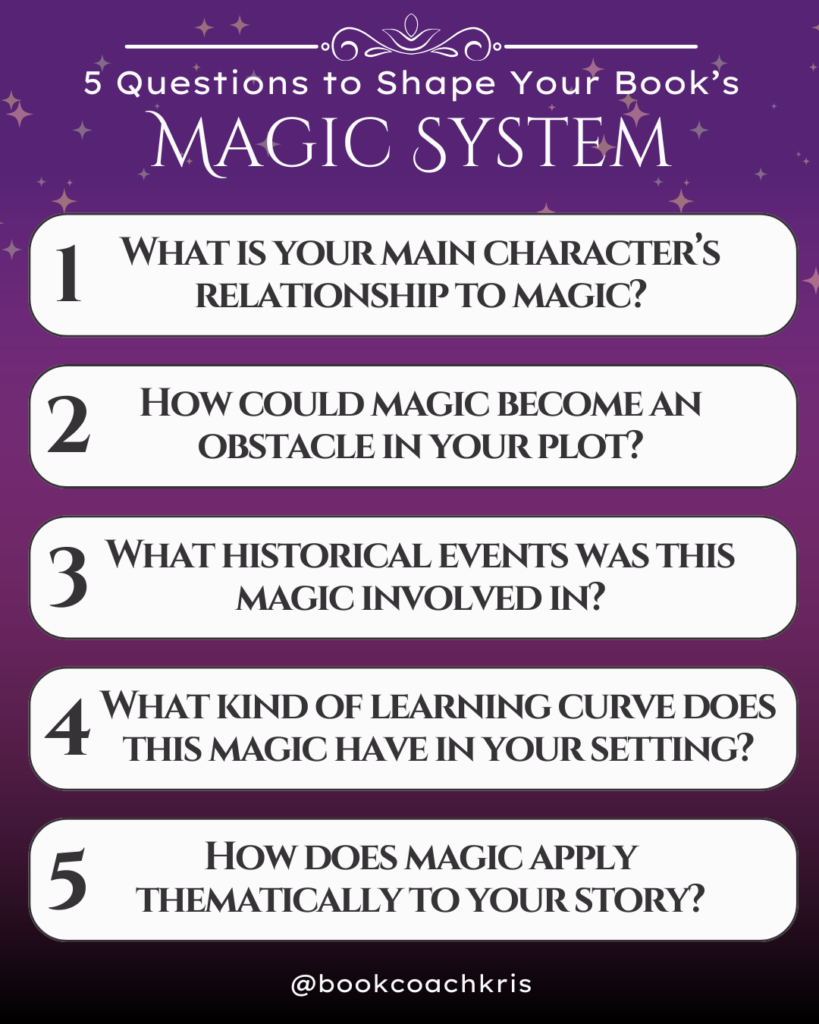
As readers, we see the fictional world through the character’s point of view. Why not give them a firm opinion on the miracles being spun right before their eyes? Unless they don’t see it as a miracle, instead caused by terrible luck or a villain from their past.
Whatever they think of magic, your answer to this question can shape the plot. Since all stories chronicle an important change, try tying in your main character’s growth arc. Does a shocking truth from the midpoint of your book change the protagonist’s feelings? Do their abilities or a spell fail them at a crucial time on their journey?
You can dig even deeper by making sure supporting characters have different reactions and histories with magic. Maybe vampires are a scourge on the world, but your main character’s sidekick is a sucker for their charms. They could fall in with the enemy, creating a key obstacle when it comes to completely defeating the vampire lord terrorizing the land.
If your goal is a well-rounded world, then showing different sides can create fascinating conflict in your story.
Are some magic sources hard to find? Does your protagonist need a rare and potent herb to save their sick mentor, but they can’t bring them along for help and advice? A moment like this is often used to show the character’s growing expertise, as well as how they are starting to shed their self-doubt.
Or towards the end of a story, the villain reveals a powerful magic that’s so complex it would break the mind of anyone who tries to unravel it. Our protagonist has spent their life trying to understand such a spell and is the only one desperate enough to try. Does it break them? Or do they uncover a new level of power that they can now command at will?
Challenges and obstacles like these create excitement for the storyline and show us exactly what our characters are made of. Coming back victorious from impossible odds feels good to readers on a primal level. Don’t be afraid to hold your characters’ feet to the fire. You just might find they’re made of tougher stuff than you planned.

Think of how the advent of gunpowder changed warfare in our world’s history. Who first discovered it, and what did they use it for? What ripple effects were caused by this discovery, and how did it directly affect the lives of everyday people, not just the one holding the gun?
History is fascinating because of how interconnected the most unassuming things can be. Imagine a fantasy book where a magical researcher accidentally ends up in a strange, dangerous world of magitech, and in their quest to return home, brings back the secrets that make these machines work. They use the techniques to revolutionize magic at home… and in turn create the magitech world they had visited. Turns out it was the future all along!
So while you may not be playing with timelines in your book, consider threading consequences from past events so they reemerge down the road, just in time for your protagonist to have to fix things themselves.
Your readers’ and characters’ understanding of magic doesn’t have to be static. In fact, it shouldn’t, because it’s rarely fun getting all the clues to a mystery, and less so if the main character is already a master.
Think about all the intricacies of education in our lives. Governments set standards to (supposedly) bring everyone to the same intellectual level, but different countries value different fields of study and thus create pockets of influence. There’s also the issue of class, where the wealthy can afford a more prestigious education, creating a cycle that systemically excludes the “Have Nots” from a good life.
Maybe your character must track down a teacher who’s hidden themselves in the mountains and refuses to leave. They hide away because the magic they command is highly dangerous, so teaching someone is out of the question! What steps would be required to tame such a deadly power? Perfect incantations? A mind free of doubt? A special mineral only found in that exact mountainside?
And if your character’s main motivation is to master this technique? That’s usually the entire middle section of a novel! Giving the protagonist a clear objective with countless steps in-between is a simple but powerful recipe for plot.
Finally, whether you’re the type to plan the theme in advance or discover it organically, think about how your magic system could be used as an allegory. One trick to nail down your theme? Ask yourself what the protagonist learns by the end of the story. If your protagonist struggles with self-doubt, then maybe your magic system can be based on each person’s level of willpower. This example may seem a bit on the nose, but stories that mean something possess major staying power.
While it is not a book, the video game Clair Obscur: Expedition 33 is a wonderful example of how a magic system can support the themes of the storyline. I won’t explain the full details (it’s a story to be experienced, not just explained), but it uses emergent storytelling over the course of the plot, letting the player discover the theme through repeated motifs and symbolism.
For example, painting terminology is integrated as a unique alternative to spells or “mana,” and once players get to the ending, it becomes obvious how integral that terminology is to the world, the plot, and especially the theme.
If you’re the type of writer who loves to explore human nature through stories, making metaphors from Fantasy elements can elevate your story from a unique thought exercise to a powerful legacy.

Finding the right balance of detail and originality for your magic system is one of the greatest challenges a Fantasy author has to face. We are unique in this, as most other fiction genres don’t require you to build entire worlds from scratch. (Though shout out to our neighbors in Science-Fiction!)
As discussed, there are many ways to flesh out your magic system, but of all of them, this is the most important question you should ask yourself: Do I have enough elements to properly tell this story?
Do you have imposing enough obstacles to challenge your characters? Does it inform the setting, making your world feel lived in? Are the abilities and sources specific enough for your needs, giving you space to weave in other elements if revision calls for it?
If you’re unsure, then it’s a great time to ask for help from beta readers! You’re often too close to the project to see things clearly. A smart editor or writing friend can point out possible plot holes or affirm that everything makes sense on the page already. We already spend too much time in our heads as creators, and we tend to be very hard on ourselves.
And remember, you can only plan your book for so long. What really counts is how everything works in the manuscript. Your creativity and ingenuity are where the real magic is.

Author Accelerator certified book coach and founder of the Inkbound Writers Circle. She writes Epic Fantasy, Romantasy, and helpful articles on writing craft. She lives in Silicon Valley with her family and her handsome cat, Sherlock.
A coaching membership that helps indie Fantasy writers finish their books and lay the foundations of a thriving business!
✒️ Connect with fellow Fantasy authors
✒️ Learn foundational self-publishing skills
✒️ Write more and plan epic fantasy worlds
✒️ Track your progress with live Q&A calls with a certified book coach
Kristin Melville is a certified book coach with Author Accelerator. Specializing in Fantasy fiction, she helps writers brainstorm book ideas and bring their worlds to life. She founded the Inkbound Writers Circle to help writers like you build a career as a traditionally or self-published author!
©2026 Kristin Melville. All Rights Reserved.